How to conquer your dream home with installments starting at $99 per month!

Have you ever stopped to calculate how much of your salary goes on filling up your car? In a scenario where gasoline prices keep rising, the electric car has emerged as a modern, silent and, above all, economical alternative.
However, even with so much technology and advantages, many people still have doubts: is it worth the initial investment? How does charging at home work? And is maintenance really cheaper?
These questions make sense, especially since we're talking about a change of habit. But ignoring this trend could cost you dearly in the future, both in terms of your pocket and environmental impact.
In this article, you will understand the real differences between a combustion car and a electric carto find out about the best-selling models in Brazil and how to save even more with solar energy and simple maintenance.
Initially, the investment in a electric car is still higher than that of combustion models. For example BYD Dolphin Mini, one of the brand's most affordable models, starts at R$ 118,800. In comparison, a popular combustion car can be found in the range of R$ 70,000 to R$ 90,000.
However, it is essential to analyze the total cost of ownership. Over the years, electric cars can generate significant savings, especially in fuel and maintenance. Several states offer IPVA exemption, free rotationThere are also incentive programs that make the electric car more attractive from a financial point of view.
In addition, the used and semi-new electric vehicle market is booming, opening doors for those who want to enter this world with less initial investment.
The monthly savings are one of the main attractions of the electric car. To give you an idea, while filling up a gasoline car can cost R$ 800 to R$ 1,200 per month, load a electric car at home costs, on average, R$ 100 to R$ 150 per monthdepending on the energy tariff.
A study carried out in 2024 revealed that the annual savings could exceed R$ 9.800considering fuel and maintenance. For app drivers, these savings can exceed R$ 2,200 per monthreaching more than R$ 25 thousand a year.
With this difference, the higher cost of buying an electric car pays for itself in just a few years.
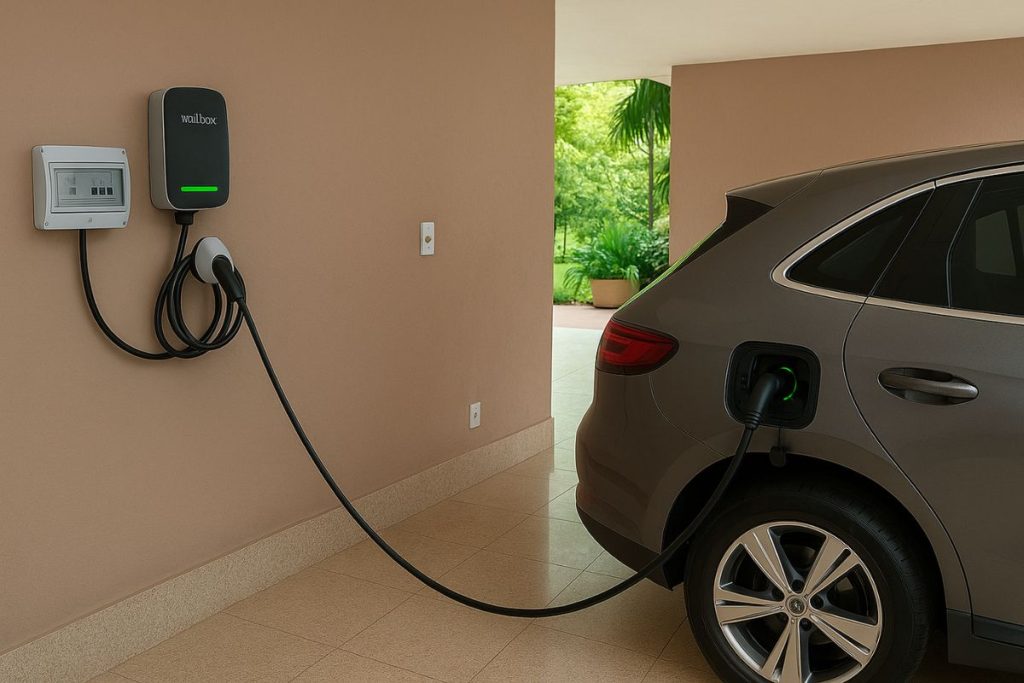
One of the biggest advantages of the electric car is the possibility of charging the vehicle at home. This guarantees convenience, safety and a much lower cost than filling up at gas stations.
Most models come with a portable chargerIt can be plugged directly into a conventional 220V socket. However, it is advisable to install a wallbox - a fixed charger, which offers more power and reduces charging time.
Investing in a wallbox varies between R$ 4,000 and R$ 8,000including the equipment and electrical installation. A full charge can take between 6 and 10 hours, ideally done overnight.
The average consumption of electric cars is around 15 kWh every 100 km. With the average energy tariff at R$ 0.66 per kWhThe cost of driving 1,000 km is approximately R$ 100. It's a fraction of the amount spent on gasoline or ethanol.
What if you could run around all month paying almost no energy? This is what many electric car owners are doing by investing in residential solar panels.
Install photovoltaic solar energy at home allows you to generate your own electricity. So, as well as saving on your electricity bill, you can fuel your car with free, clean energy.
A residential 3 kWp is enough to meet the average consumption of a house and still charge an electric car that runs about 1,000 km per month. The cost of a solar system is around R$ 15,000 to R$ 20,000with a return on investment of up to 4 years.
By combining electric car + solar panelsthe environmental impact becomes practically nil. It's a green 100% solution that reduces CO₂ emissions and makes your home and your mobility self-sufficient.
One of the great advantages of electric vehicles is the low cost of maintenance. With fewer moving parts and simpler systems, the need for overhauls is drastically reduced.
This already eliminates much of the recurring costs of combustion vehicles.
While overhauls on combustion cars can exceed R$ 1,000The cost of servicing an electric car is between R$ 300 and R$ 500and less often.
The Brazilian market is becoming increasingly competitive. Here are the models best sellers in 2024 by brand:
BYD is the fastest-growing automaker in the electric segment in Brazil. Among its best-selling models:
Many consumers are still wary of charging infrastructure. But the scenario is changing rapidly:
The trend is for exponential growth in the coming years, with partnerships between carmakers and energy companies to speed up the installation of new points.
Major automakers have already announced deadlines for abandoning the production of combustion vehicles. Countries such as the UK, France and Norway have set targets for selling electric vehicles only from 2030 or 2035.
In Brazil, progress is still gradual but promising. With tax incentives, improvements in infrastructure and falling prices, the electric car is likely to become the dominant option over the next decade.
Yes, it's worth it. Although the initial price is still higher, the long-term cost-benefit is undeniable. The monthly savings on fuel, the low maintenance costs and the possibility of using solar energy make the electric car a strategic and sustainable decision.
What's more, the experience of driving an electric vehicle is more comfortable, quieter and more technological. It's a choice that combines economy, innovation and respect for the environment.












 English